

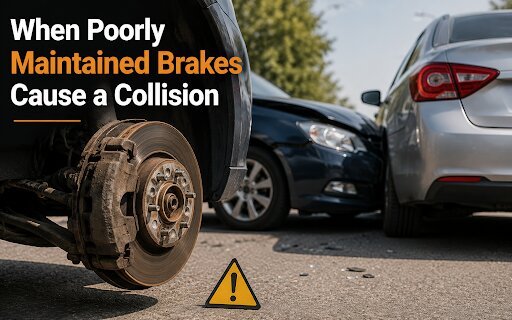
Drivers depend on their brakes every time traffic slows, a light changes or a hazard suddenly appears. When a vehicle’s braking system has been neglected, however, an ordinary stop can become impossible. The result may be a rear-end collision, intersection crash, pedestrian accident or high-speed wreck causing severe injuries.
A driver generally cannot avoid responsibility simply by saying, “My brakes failed.” Vehicle owners and drivers are expected to keep their cars in reasonably safe operating condition. When someone continues driving despite worn brake pads, leaking fluid, damaged brake lines or other warning signs, that failure to maintain the vehicle may be evidence of negligence.
Liability is not always limited to the driver. Depending on what caused the brake failure, responsibility could also fall on the vehicle owner, a repair shop, an employer, a commercial carrier or the manufacturer of a defective brake component.
How Poorly Maintained Brakes Cause Accidents
A braking system contains multiple components that must work together to slow and stop a vehicle. A problem with one part can reduce the effectiveness of the entire system.
Common brake-related maintenance problems include:
- Worn or damaged brake pads
- Thin, warped or cracked rotors
- Leaking brake fluid
- Corroded or ruptured brake lines
- Failing calipers
- Worn brake shoes
- Air or moisture in the hydraulic system
- A malfunctioning master cylinder
- Improperly adjusted brakes
- Overheated or contaminated components
- Unresolved dashboard warning lights
Inadequate brake fluid and neglected brake lines, pads or shoes are among the maintenance failures that can contribute to brake-related collisions.
Poor brakes do not always fail all at once. A vehicle may first require more distance to stop, pull to one side, vibrate under braking or respond inconsistently. At highway speeds, compromised brakes can also reduce stability and control during sudden maneuvers.
Warning Signs That Brakes Need Attention
Brake problems often provide warnings before a serious failure occurs. A reasonable driver should not ignore signs such as:
- Squealing, scraping or grinding noises
- A soft or spongy brake pedal
- A pedal that travels unusually close to the floor
- Steering-wheel or pedal vibration
- The vehicle pulling to one side
- A burning smell near the wheels
- Brake fluid beneath the vehicle
- Increased stopping distance
- Brake or ABS warning lights
A mechanic’s recommendation that repairs are needed
Grinding may indicate that brake pads have worn through and metal components are making direct contact. A soft pedal may indicate air, fluid loss or hydraulic trouble. Pulling to one side could suggest uneven pad wear, a sticking caliper or another imbalance in braking force.
A driver who recognizes these warning signs but continues operating the vehicle may have difficulty arguing that the eventual collision was completely unexpected.
Can a Driver Escape Liability by Claiming Brake Failure?
Usually, brake failure is not an automatic defense to a car accident claim.
The central question is often whether the driver acted reasonably before and during the emergency. Relevant issues include whether the driver:
- Knew the vehicle had brake problems
- Had recently experienced warning signs
- Was told by a mechanic that repairs were necessary
- Received a recall or safety notice
- Failed to obtain routine inspections
- Continued driving after the brake warning light appeared
- Drove too fast for the vehicle’s condition
- Followed another vehicle too closely
- Had enough time to pull over safely after noticing a problem
A driver who knew the brakes were making unusual noises or had been advised that service was required may be held responsible for continuing to drive without arranging repairs.
Even when the brake problem arose unexpectedly, the driver’s actions immediately before the crash remain important. A person following too closely or speeding may still share responsibility because those choices left insufficient time and space to respond.
The Vehicle Owner May Be Liable for Negligent Maintenance
The person driving the vehicle and the person who owns it are not always the same. A vehicle may belong to a family member, business, rental agency or commercial fleet.
An owner may be liable when the owner was responsible for maintenance and failed to keep the braking system in safe condition. For example, an owner could face a negligence claim after:
- Ignoring repeated brake complaints
- Refusing to authorize recommended repairs
- Failing to schedule routine service
- Allowing an unsafe vehicle to remain in use
- Concealing known mechanical problems from the driver
- Lending the vehicle despite knowing the brakes were defective
Liability depends on who controlled the vehicle, who was responsible for servicing it and what each person knew about its condition.
In some situations, both the driver and owner may be responsible. The owner may have failed to maintain the vehicle, while the driver may have noticed clear warning signs and continued driving anyway.
What Must Be Proven in a Brake-Maintenance Negligence Claim?
The precise legal requirements vary by state, but an injured person generally must establish four basic elements of negligence.
Duty
The responsible person had a duty to use reasonable care. Drivers and owners generally have a duty to operate and maintain vehicles in a reasonably safe condition.
Breach
The person failed to meet that duty. Examples might include ignoring grinding noises, failing to replace worn pads or continuing to drive after a mechanic identified a dangerous condition.
Causation
The maintenance failure must have caused or substantially contributed to the collision. It is not enough to find an unrelated maintenance problem after the crash.
Damages
The collision must have caused measurable harm, such as physical injuries, medical expenses, lost income, property damage, pain or disability.
A strong case typically requires more than proving that the vehicle had bad brakes. The evidence must connect the neglected condition to the driver’s inability to stop or control the vehicle.
Who Could Be Responsible for a Bad-Brake Collision?
Several parties may bear responsibility, depending on the cause of the failure.
The Driver
The driver may be liable for operating a vehicle that they knew—or reasonably should have known—was unsafe.
The driver may also be negligent for:
- Speeding
- Tailgating
- Distracted driving
- Failing to respond to warning lights
- Continuing to drive after noticing reduced braking ability
- Failing to use the parking brake or other emergency measures when appropriate
- Driving the vehicle after being told not to do so
The Vehicle Owner
A vehicle owner may be liable for failing to inspect, maintain or repair the brakes, particularly when the owner controlled the maintenance schedule.
An Employer or Commercial Vehicle Company
When the vehicle is owned or operated for work, an employer or transportation company may be responsible for inadequate inspections, deferred maintenance or poor recordkeeping.
Commercial operators may have formal inspection and maintenance obligations. Evidence may include fleet maintenance logs, driver inspection reports, repair invoices and internal communications.
A Mechanic or Repair Shop
A repair facility may be responsible when negligent service causes or contributes to brake failure.
Examples include:
- Installing the wrong parts
- Failing to properly secure a brake line
- Using contaminated fluid
- Installing pads or calipers incorrectly
- Failing to diagnose an obvious problem
- Returning a vehicle to the customer in an unsafe condition
- Claiming repairs were completed when they were not
A shop is not automatically liable merely because it previously worked on the vehicle. An expert may need to determine whether the work fell below accepted professional standards and whether that error caused the crash.
A Brake-Part or Vehicle Manufacturer
Sometimes the brakes fail because of a design or manufacturing defect rather than neglect.
Potentially responsible companies could include the:
- Vehicle manufacturer
- Brake-component manufacturer
- Parts supplier
- Distributor
- Dealership
Product-liability claims may arise when brakes were defective when sold, were inadequately tested or lacked appropriate warnings. Manufacturers and other parties involved with the brake system may be liable when defective components cause a crash.
A Rental or Leasing Company
A rental or leasing company may face liability for its own negligence if it knowingly provided a vehicle with unsafe brakes or failed to perform required maintenance. The specific legal rules governing rental-company liability vary.
Maintenance Failure or Product Defect?
One of the most important questions is whether the brakes deteriorated because they were neglected or failed because they were defective.
Evidence of Poor Maintenance
Indicators of neglected maintenance may include:
- Brake pads worn beyond recommended limits
- Severely corroded lines
- Old or contaminated fluid
- Missed service intervals
- Prior repair recommendations
- Warning lights that were ignored
- No maintenance records
- Temporary or makeshift repairs
Evidence of a Product Defect
Indicators of a possible defect may include:
- A new or recently serviced component failing unexpectedly
- Similar reported failures involving the same part
- A safety recall or technical service bulletin
- Fractured components showing abnormal material failure
- Proper maintenance records with no prior warning signs
- A component installed correctly but unable to function as designed
Determining the cause often requires an inspection by a mechanical engineer, brake specialist or accident reconstruction professional. Defect claims can be difficult to establish without expert analysis.
Why the Condition of the Vehicle Is Critical Evidence
The vehicle itself may be the most important evidence in a brake-failure case.
After a collision, an insurance company, repair shop, salvage company or owner may quickly repair, sell or dispose of the vehicle. Once brake components are replaced or destroyed, it may become much harder to determine what went wrong.
An injured person or their attorney may send a preservation notice instructing relevant parties not to:
- Repair the brake system
- Remove or discard components
- Alter the vehicle
- Download or erase electronic data
- Sell the vehicle
- Transfer it to a salvage yard
- Destroy maintenance records
A qualified expert can then examine pad thickness, rotor condition, fluid levels, hydraulic pressure, line corrosion, caliper operation and other relevant components.
Evidence That Can Prove Brake Negligence
Brake-maintenance cases may depend heavily on records that are not visible at the accident scene.
Important evidence may include:
Maintenance and Repair Records
Invoices may show when the brakes were last serviced, what work was recommended and whether the owner declined repairs.
Mechanic Testimony
A mechanic may confirm that the owner or driver was warned about a dangerous condition before the crash.
Dashboard Data and Warning Lights
Photographs, diagnostic codes or vehicle data may establish that warning lights were active.
Event Data Recorder Information
Some vehicles contain data showing speed, brake-pedal application, throttle position and other information from the moments before impact.
Vehicle Inspections
A forensic inspection may identify worn parts, leaks, improper installations or defective components.
Photographs and Video
Images from the scene may show fluid leaks, skid marks, tire position and vehicle damage. Surveillance or dashcam video may reveal whether the vehicle slowed before impact.
Driver Statements
Statements such as “the brakes have been acting up” or “I was supposed to take it to the shop” may become significant evidence.
Text Messages and Emails
Communications between a driver, owner, mechanic or employer may document prior knowledge of the problem.
Recall and Service Information
Recall notices, manufacturer communications and service bulletins may help determine whether the failure involved a known defect.
Can the Absence of Skid Marks Prove the Brakes Failed?
Not necessarily.
Modern vehicles commonly use anti-lock braking systems, which can reduce or alter traditional skid marks. Road conditions, tire condition, speed and the type of brake failure may also affect whether marks appear.
The absence of skid marks does not conclusively prove that the driver failed to brake or that the brakes were defective. Accident reconstruction may require analyzing:
- Tire marks
- Vehicle data
- Impact severity
- Crush patterns
- Road grade
- Surveillance footage
- Witness accounts
- Brake-component condition
No single piece of evidence should usually be evaluated in isolation.
What If the Driver Recently Had the Brakes Repaired?
Recent repairs can raise additional questions, but they do not automatically establish that the repair shop was responsible.
Investigators may examine:
- Which components were serviced
- Whether the work related to the failed part
- Whether the correct parts were installed
- Whether installation procedures were followed
- Whether the shop recommended additional work
- Whether the customer declined repairs
- How many miles the vehicle traveled after service
- Whether a different maintenance issue caused the failure
Responsibility may be divided. For example, a repair shop might have negligently installed a component, while the owner might have ignored a warning that the vehicle still required additional work.
Brake Failures in Commercial Truck Accidents
Brake-maintenance failures can be especially dangerous in crashes involving tractor-trailers, buses, delivery vehicles and other heavy commercial vehicles.
Large vehicles require more distance to stop and place significant stress on their braking systems. Frequent use, heavy loads and steep grades can cause overheating and accelerated wear.
Potentially responsible parties in a commercial brake-failure crash may include:
- The truck driver
- The trucking company
- The fleet owner
- A maintenance contractor
- A freight company
- A loading company
- A brake manufacturer
Another company responsible for inspections
Commercial cases may involve driver inspection reports, maintenance schedules, electronic logging information and corporate safety policies. A trucking company may face liability when it fails to maintain its vehicles or follow inspection and repair procedures.
What Should You Do After a Crash Involving Suspected Brake Failure?
Call Law Enforcement
A police report may document statements made by the driver, visible fluid leaks, mechanical problems and witness information.
Seek Medical Attention
Obtain prompt medical care even if symptoms initially appear manageable. Some injuries become more noticeable after the shock of the collision subsides.
Photograph the Vehicles and Road
Take photographs or video of:
- Vehicle damage
- Fluid beneath the vehicles
- Tire and skid marks
- Traffic signals
- Road conditions
- Warning lights, when visible
- The interior and pedals
- Any detached vehicle parts
Listen for Statements About the Brakes
A driver may spontaneously admit that the brakes had been making noise, that a warning light had been on or that repairs were overdue. Record the substance of any statement and identify who heard it.
Identify the Vehicle Owner
Confirm whether the driver owns the vehicle. Obtain the names of any employer, rental company, leasing company or commercial carrier connected with it.
Avoid Allowing the Vehicle to Disappear
When possible, request that the vehicle and brake components be preserved for inspection.
Notify the Appropriate Insurers
Report the accident to your own insurer and obtain the other driver’s insurance information. Avoid speculating about the mechanical cause until the evidence has been evaluated.
What Compensation May Be Available?
A person injured in a collision caused by poorly maintained brakes may be entitled to compensation for losses such as:
- Emergency care
- Hospitalization
- Surgery
- Rehabilitation
- Future medical treatment
- Lost wages
- Reduced earning capacity
- Vehicle damage
- Transportation expenses
- Physical pain
- Emotional distress
- Disability
- Disfigurement
- Loss of enjoyment of life
In a fatal collision, eligible relatives or the estate may be able to pursue damages through a wrongful-death or survival claim. The available categories and filing deadlines vary by state.
What If More Than One Party Was Negligent?
Brake-related collisions often involve overlapping negligence.
For example:
- The owner may have failed to replace worn brake pads.
- The driver may have been following too closely.
- A mechanic may have improperly installed a brake line.
- A manufacturer may have supplied a defective component.
When several parties contributed to the accident, fault may be divided among them. The injured person’s recovery may also be affected if their own conduct contributed to the collision.
States use different contributory- and comparative-fault rules, so the effect of shared responsibility depends on where the accident occurred.
Poor Maintenance Can Turn a Preventable Problem Into a Serious Crash
Brakes are wear components that require regular inspection, maintenance and replacement. A sudden mechanical problem may sometimes be unavoidable, but many brake-related accidents are preceded by noises, warning lights, fluid leaks, poor stopping performance or repair recommendations.
When a driver or vehicle owner ignores those warnings, a claim of unexpected brake failure may not relieve them of responsibility. The investigation should identify who controlled the vehicle, who maintained it, what warning signs existed and whether negligent repair or a defective component contributed to the collision.
Because the physical evidence can quickly be lost, preserving the vehicle and its maintenance history is often essential to determining why the brakes failed and who should be held accountable.
This article provides general educational information and is not legal advice. Vehicle-maintenance laws, negligence standards, fault rules and claim deadlines vary by state. Anyone involved in a collision involving suspected brake failure should consult a qualified attorney in the state where the accident occurred.